White-Tinted Glasses

Written by: Dalyah Schiarizza

I’ve only begun reflecting on what it means to be a woman of colour. For most of my life, it hardly even crossed my mind. I had an ignorance that protected me for so long until I came to a point in my life where that protection vanished. I find that I was socialized like a White person in an entirely White family. My brain was crafted in a way that shielded my understanding of the effects racism has had on my life, previously and currently. That doesn’t mean I grew up not knowing what racism is. It just means I had the minimal understanding that racism is wrong, but it’s essentially over, a thing of the past. It took me a long time to come to the harsh realization that racism exists in all facets of society, and it will influence my wellbeing, whether or not I’m aware of it. I say I wore white-tinted glasses for 18 years, and it’s just now that I’m beginning to navigate and understand my identity as a biracial woman. It’s taken me one more year to establish this partially nuanced understanding and how it has influenced my life. 

I want to start at the beginning; I spent a large portion of my life in a tiny and predominantly White town. I was the only Black person in my classes and family, so I grew up exclusively by and around White people. I learned to see the world as a White person, but obviously, it doesn’t work like that for me. I didn’t even know the world would be different for me and; it took me a very long time to let it sink in. These white-tinted glasses acted as a double-edged sword. It was a form of protection that shielded me from recognizing a lot of microaggressions and isolation. Still, it was blocking me from understanding who I am and the culture I could have had. In hindsight, I now recognize that I was being denied the truth of what it means to exist in this world, and I found myself shocked and underprepared. 

Throughout school, I usually faced a lot of racist jokes, suggesting I could run fast or that I couldn’t be seen in the dark. They would comment on how I probably liked fried chicken and watermelon or how I was “loud” and talked “ghetto.” My peers would make these comments and laugh at me. In those moments, they didn’t impact me because, for some reason, it didn’t click how my peers directed those jokes at me. I was the butt of their joke, and I was who they projected their narrow-mindedness onto. Often I’d just laugh it off since I didn’t get it was about me and likely because I didn’t want to seem so different from everyone else. I wish I understood and said something, so maybe I would have earlier understood who I was. I wish it clicked a lot sooner that what they were saying was targeted at me. I had white-tinted glasses on, I had a very underdeveloped understanding of racism and of myself as a racialized person in situations like this. For example, when they said I couldn’t be seen in the dark, I laughed because it was just an assumption, or that’s how I understood it. Exactly like how the White kids around me understood it as just an assumption. Now, I realize that what they were saying was targeted at me in a racist way.

Even in public, strange things would happen to me because people had racist assumptions, and I never realized it. There have been a few times when I’d go into stores with my friends or family, and there would always be at least one store employee watching me. Even if I’d have been to that store fifty times and nothing ever happened when I was there, employees constantly watched me. I didn’t realize it; I just thought that maybe they did it because I was young, I was freshly 14 at the time, but it never crossed my mind that they did it because I’m Black. I also remember being asked to leave my purse outside of a dressing room because of “new anti-theft policies,” but the staff asked no one else to do that. At the time, I didn’t understand why they had only asked me. I assumed that maybe the employee forgot to ask the others. I’d say these were a couple of instances where I had on my white-tinted glasses, and they blinded me from understanding these micro-aggressions. 

Even though I wish I didn’t grow up with white-tinted glasses, I realize now that  they were a form of protection. If I did understand that those kids were being racist and that store employee stereotyped me as a thief because I’m Black, what could I have done? Who could I relate to? Would I tell my teacher and there be a discussion about not saying racist things when only one person of colour is in the class? I grew up without a diverse community or friends of colour, but I never understood that either. I was granted protection from a lot of isolation and loneliness from actively realizing I’m the only one not like the people around me. 

The most crucial part in my journey of realizing my identity as a woman of colour was when I lost my white-tinted glasses. Like many others, I was exposed to the well-disguised reality of police brutality towards Black people in May 2020 when the entire world watched the death of George Floyd. For me,  that’s when my white-tinted glasses fell off and shattered in front of me. I was exposed to a whole new world, the reality that I needed to face as a woman of colour. A reality that has hurt me and will continue to hurt me that I was entirely oblivious to. 

I was overwhelmed because when I lost those glasses, I felt dumb like I was missing information that everyone else had. I felt like I was an idiot for not knowing how extensively racism has impacted and will impact my life, especially in predominantly white spaces. I also felt invalid as a woman of colour because I did not know since I was never raised around Black culture. When people would ask me questions about racism and Black history, I had no clue how to answer them seven times out of ten. Those interactions were very invalidating, not because people asked me, but because I didn’t have the slightest clue on how to answer them. Those white-tinted glasses blinded me from the world around me. When I lost them, I had no understanding of myself because I only understood the world from a white perspective. 

Another very detrimental impact of losing my white tinted glasses was how I became extremely anxious. I found myself worrying a lot more about the environments I was in. For example, I was worried that someone was watching me all the time or that people I saw had intentions of hurting me. This was not the case, but my brain panicked because the sense of self I had growing up was shaken, and nothing felt familiar anymore. Those glasses likely protected me from a lot of isolation as a kid, but they ruined me when I was eighteen. I was terrified and felt like a shell of myself. Based on my upbringing, half of my identity was underdeveloped and never understood. I only began to process that about a year and a half ago. 

I can say I’ve made a lot of progress since losing my white-tinted glasses. I’ve reflected on my experiences and related it to the phrase “white tinted glasses” as a start. Now that those glasses and I have parted ways, it has created the opportunity for a valuable journey of self-discovery. I wish I could tell you that I have it all completely figured out, but I don’t. I am only getting started. One thing that was very important to me was meeting other people of colour, especially Black women since I never grew up around other people of colour. I want a sense of community because I don’t want to go through this experience alone. I’m not the only person who has dealt with anti-Black racism or is a woman of colour in primarily white spaces. It’s vital to have a community because it can help me rationalize my insecurities and questions about my Black features. For example, caring for my curly hair or how my appearance is often fetishized as “caramel.” That’s part of the reason I was inclined to attend some QWOCC meetings last year and write for them this year. I am starting to feel connected to other women of colour with similar experiences and backgrounds.

I have also realized that I shouldn’t be ashamed to learn and do so publicly and actively. In the past, I’ve felt very ashamed of not having the understanding I do now about racism and the Black identity. I deserved to have it, but it was never my fault because I was young and couldn’t control it because I didn’t even know what it was. Six months ago, I couldn’t imagine writing so honestly about one of the biggest obstacles in my life right now, but I am doing so unashamedly. Learning about what it means to be a biracial Black woman has become very important to me. I now understand that I have a unique positionality, but I want to know the nuances of my identity, too. How will my specific identity influence my future, and how has it impacted events in my past? My questions are not answered yet, but I am nevertheless very committed to discovering their answers. I know that there’s no 100% right or wrong answer, but I want to entrench myself in this and navigate these questions and find what makes the most sense to me. 

My reflection on being a woman of colour has just begun, as my story has shown. It took me a long time to get to this point, but I am glad I made it and am excited to keep moving forward. I wish I were brought up around Black culture and people, so I didn’t have to live with my white-tinted glasses for as long as I did, but that process has made me stronger. I am more dedicated to learning and understanding it as an adult with an open mind to rationalize and connect the patterns between the institutions of our society and the events of my life. Every day, I am grateful I’ve lost those glasses because regardless of how scary it was at first, I can now live my life more authentically and experience and understand my reality correctly now. 
Today

Written by: Rana Salman

Like many women of colour, I spent a lot of my adolescence feeling isolated. I grew up in a predominantly white area where I was asked countless probably-innocent questions about my skin, my hair, and my culture. For most of my youth, I was among the few people of colour in my class, and typically the sole black girl in a room. 

Unfortunately, I spent a lot of time ignoring this part of me. In typical pre-teen fashion, I wanted to fit in. I begged my mom to straighten my hair, I spoke differently, and I hid parts of me that I am proud of today. 

Today, I no longer feel like a token. Don’t get me wrong, I still often find myself being the only black girl in a room, but now, instead of hiding, I know I’m entitled to the same space as others. 

I stopped seeing my differences as negatives but started viewing them as positives. This mindset was and is hard to adopt. Sometimes, I still find myself thinking old thoughts and worrying about the parts of me that make me different. There are countless factors that play into beginning to change your mindset –  the most helpful one for me involved reminding myself that being a minority does not mean you have to make yourself fit into the majority. 

Today I don’t regulate my blackness, I refuse to make myself ‘easier’ to tolerate, and I don’t let being different make me feel weak.     

Allyship: It Begins With Us

Written by: Serena Sengupta

Graphic by Serena Sengupta

A quick google search returns the definition of an ally as “being a person or organization that cooperates with or helps another in a particular activity”. 

What does this mean? Why is it important?

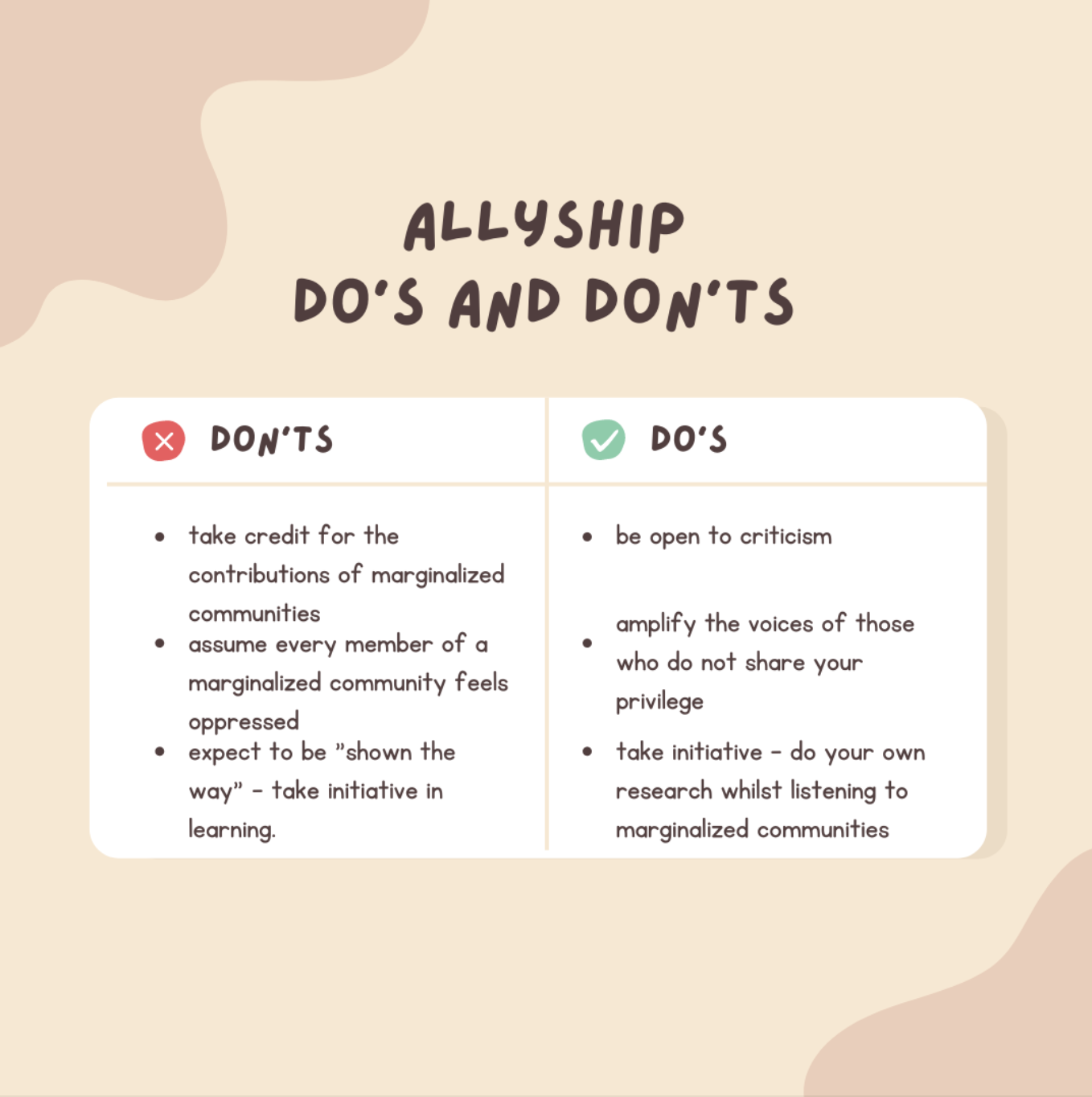
Being an ally isn’t easy; it requires constant attention and awareness of the situations we are in. Allies must recognize that despite possibly not being a part of a marginalized community, they must make an effort, every day, to understand the struggle that people within these groups face. Allies often have more privilege, granting them great power to amplify oppressed voices. Allyship is a concerted decision made actively, all of the time. 

With this in mind, it is always a good idea to have a baseline idea of where to start in being an ally. 

It’s absolutely crucial to listen to marginalized voices and use your privilege to amplify them, whilst accepting criticism in your allyship. Always evaluate your implicit bias, which is when we have “attitudes towards people or associate stereotypes with them without our conscious knowledge”. Be more than a performative ally – put in the work in your everyday life, even when no one may be watching, and not just to impress an online following.

Most of all, always be willing to constantly grow and learn through the process of being an ally.

Sources:

Am I Doing Enough As An Ally?

Written by: Sylvia Kathirkamanathan

The term ally is easily thrown around in today’s society, but is it being executed to its best potential? What separates a good ally from a performative ally in today’s world? As a South Asian woman of colour, I find myself reflecting on what I do in my daily life to be a good ally to marginalized groups around me, both those I am part of and those I am not. 

First and foremost, what is an ally? In short, an ally is an individual who supports a community and uses their position in society to advocate for that group in the best way they can. Opposingly, performative allyship is defined as being an ally with the expectation of something in return; supporting a cause to boost a personal agenda. Examples include simply reposting posts on social media when a cause or issue is “trending”. 

The reason I question whether I do enough as an ally for women of colour is because of microaggressions. Microaggressions are behaviours or actions communicated towards a marginalized group contributing to negative or stereotypical ideologies. The question I ask myself is: do I do enough to combat microaggressions targeted at me or around me for being a South Asian woman of colour or do I let them go past me, which does more harm than good in the long run? Moreso, by allowing microaggressions to be tossed around, am I being a performative ally? 

I have definitely been on the receiving end of these actions several times, whether they are  from teachers, friends, co-workers, or even strangers. I find that I allow those around me to make microaggressions towards me, whether intentional or unintentional, and I can’t seem to figure out what to do about it at the moment. After much thought, I don’t believe not combating microaggressions as much as I would like makes me a performative or bad ally but rather, it comes from a place of fear. I believe I am scared of the reaction I would receive from speaking out, which I am sure many can relate to. That being said, I hope to make changes in my life where I am ready and comfortable enough to start these difficult conversations, not only to be a good ally to other South Asian women, but to make myself and others more comfortable in the environments I occupy.

I believe a good place to start is to facilitate a conversation, whether that be in the moment or when you are comfortable. I find this to be the best approach when talking to someone you know or want to discuss the issue with, such as a friend. Sometimes, opening a safe space for discussion and questions allows the microaggressor to understand where you are coming from and they can hopefully learn from their mistakes for the future. I hope to implement this solution to microaggressions moving forward and be the most authentic and effective ally I can be.

What’s In a Name

Written by: Jade Courchesne

“F**k, I’m in a group with international students.”

Let’s unpack this sentence. 

Let’s talk about how someone I used to know would look at a list of names for a group project and assume that the outcome would be detrimental to their grade; that they would be pulling all the weight; that the assignment would take twice as long to finish; that they “can’t even pronounce the names of the people in their group” and couldn’t be bothered enough to try. 

Now throw yourself into the position of a new student, in a new city, on a new continent. You’re away from your parents, your home, your old connections. You’re filled with such a deep-seated sense of homesickness that you feel nauseous half of the time. So, you try to meet people, you try to work harder, to socialize. You build networks; you build a home. You go to class; you work on group projects. And then your efforts are immediately dismissed. On the mere basis of a name on a sheet of paper. 

For many international students, the academic challenges that often come along with being a university student can be exponentially more daunting, especially if their grasp of the local language is not as strong as the others around them. That said, these students are frequently not even given the chance to meet their group members before being confined to the stereotype of the anti-social foreigner or the lazy freeloader. Speaking personally, I have noticed an uncomfortable trend that tends to run through some of my local Canadian classmates. The specific reaction that I spoke of at the start of this article came from a conscious bias against Asian-identifying international students with Chinese names like ShunTing, or XinJie. Their names were picked apart and mocked by this person, who then went on to complain about the quality of their work merely because of a few grammatical errors that could have easily been fixed at the click of a button. It’s not lost on me that the very same person had no trouble learning the pronunciations of their Eastern European colleagues, whose names were arguably more complex and less phonetic. 

Mispronouncing someone’s name, especially when done so intentionally, presents a lack of care in respecting a person’s individuality. It’s a decision to use their background against them, to weaponize their ‘otherness’, and to invalidate their existence in a culture that continues to prioritize whiteness. My own last name, Courchesne, blends in well enough with the other names on my course list. I am, on paper, free of the negative expectations that come with a foreign name. Though, this then culminates to a surprise for groupmates who notice my biracial background and make it a point to congratulate me on my grasp of the English language, as though they were expecting otherwise based on my appearance. My friends with East Asian last names like Chiu and Lee are given the same treatment, despite English being their first language. Importantly, we are not wrong for making initial assumptions about others, in fact, it’s how we learn about one another, how we start to break down the barriers between different cultures and backgrounds. But, when the assumptions are never corrected, they can become harmful to those who are just trying to succeed in a new environment that is quick to judge them.

To be a sincere ally to a marginalized community is to be patient and empathetic. It’s to ask questions that come from a place of genuine curiosity, rather than ostracizing the students that could already be having a difficult time processing the same information in a second language. We are not defined by the assumptions we make, but rather by our humility in acknowledging that we can be wrong. Ask them how their name is pronounced and respect its ties to that person’s individual heritage. When working in a group setting, it’s not a bad idea to ask for clarification if you need it, to make sure that the team is on the same page moving forward. Chances are that most people are interested in working towards a good outcome if they feel motivated and comfortable in a collaborative process. We have the privilege and benefit of being native English speakers, something that gives us an advantage in helping other people where they might need it. Create a supportive environment where international students need not feel excluded and isolated from the in-group. I would also recommend directing them to other resources that could help them thrive both socially and academically. It’s the little things that can really turn someone’s day around, especially if they feel beaten down by repeated frustrations with a system that does not prioritize them. Had I inherited my mother’s last name instead of my father’s, I would have been a part of the group that the student was talking about when they looked at their class list and said “f**k, I’m in a group with international students.” Give your groupmates a chance to be themselves, to exist outside of your preconceptions. I promise that they will appreciate the extra mile and you will be surprised at what you could learn from someone who may think differently than you do, given the right time and space. 

Being a Real Ally

Written by: Rana Salman

Allyship is a powerful and beneficial trait that we often hear a lot about, but what does that really look like? 

Social media posts are probably what many think of when considering what allyship means in 2021. They think posting black squares to their timelines, retweeting statistics and reposting articles to Instagram stories is enough. While exposure can be great in terms of spreading awareness about various social justice issues, it can be insincere and performative if not followed by real action. 

Real allyship takes time; it takes more than sharing a couple posts, or reading a couple articles. In my opinion, allyship starts with a personal intention and commitment to learning. Now, we can all say we’ll educate ourselves, but this is a lifelong dedication: to be an ally is to commit to being a lifelong learner. 

Allyship means reading, listening, and deepening your own understanding of various topics. It’s easy to think you can simply ask marginalized groups about their experiences but it’s important to remember – that’s not their job. Still have questions? Make sure you preface any discussions by requesting permission to ask about certain topics rather than just asking. Also, remember that everyone’s experience might not be the same, don’t generalize stories from one or two people, be considerate of people’s unique experiences and individuality. 

Be an ally by starting with yourself, recognize that there will always be things to learn and some things you might never understand. 

How to Become an Ally to Women of Colour

Written by: Sophia Wang

Most definitely you have heard or seen the phrase “become an ally,” but what does this really mean, and how can this be achieved? There are many ways to become an ally, including being an ally to people of colour, an ally with the LGBTQ community, or an ally for women’s rights. Regardless of what ally you choose to be, it is important to understand that the fundamental principle of being an ally is education and understanding the community. 

Firstly, what is an ally? 

An ally is someone who supports and understands the beliefs of a community and promotes a common interest. Understanding the beliefs of a community goes hand in hand with understanding the barriers that a community faces in society. For example, in society, women face social, economic, and political inequalities. The gender pay gap is most prevalent in developing countries, however, in a well-developed country like Canada, you would assume there is gender equality in the workforce. Unfortunately, Canada is ranked with the “8th highest gender pay gap out of a list of 43 countries examined by the OECD (Organization for Economic Cooperation and Development), based on 2016 data” (Canadian Women Organization, 2021). This income inequality not only affects women in the workforce currently, but also young women who are studying to pursue their dreams and have an additional barrier of making their way into the male-dominated workplaces. Therefore, learning about the inequalities and barriers against women in the workforce is the first step in becoming an ally. 

It is also important to recognize the presence of racism in our society. It has been extremely clear that racism is an ongoing problem in all sections of society. For example, during March of 2020, “Black Lives Matter” Protests rose across the world to advocate and bring awareness to police brutality and racism. It is important to know that although protests surfaced in 2020, the racial discrimination and inequalities that people of colour face have been present for decades, and are still present to this day. Education and understanding the barriers, discrimination, and fears that people of colour face daily is the biggest step in becoming an ally. This can be done by watching documentaries, listening to podcasts, and learning from knowledgeable and credible sources. Once the foundation of education is achieved, action can be taken by being attentive about what you say and what other people say. Ensure that no racial slurs, actions, or racially motivated attitudes are performed. It is important to get the conversation rolling; talk to your family, peers, and colleagues about racism and how everyone can be more conscious about the actions and words that are said. Discussion and communication are the best methods in keeping everyone accountable for their actions and being an ally. 

It is now important to realize that women of colour are extremely marginalized because they face both the barriers of racism and gender inequality. Women of colour face barriers in the workplace, education, businesses, and healthcare. There is a lack of diversity and representation in the workforce, politics, and education. As allies, it’s important to combat injustice, and promote equity and diversity at school, at work, or just publicly in general. Women of colour are often marginalized and underrepresented, therefore, their opinions are less likely to be voiced and listened to. As an ally, your role is to listen and encourage the voice of women of colour and assist them when in need. For example, promoting and encouraging businesses owned by women of colour, or voice lack of diversity in a workplace.  

Ultimately, to be an ally to women of colour, it is critical to understand and learn about the history of systemic racism, gender inequality, and the first-hand experience of women of colour. Here are some resources that are extremely helpful in becoming an ally and supporting women of colour. 

Movies, documentaries, and podcasts to listen to: 

Podcast: The Colour Gap: How to Become and Great Ally to Women of Colour: 

Documentary: Say Her Name: The Life & Death of Sandra Bland (2018) 

Documentary: He named me Malala 

Book: In Search of Our Mothers Gardens by Alice Walker  

References

Canadian Women Organization. (2021, June 05). The Gender Pay Gap: Wage Gap in Canada: The Facts.  

Retrieved from: https://canadianwomen.org/the-facts/the-gender-pay-gap/ 

Understanding the Difference Between Performative Activism and Genuine Allyship

Written by: Mehak Narula

In the world of social media, it is becoming increasingly hard to connect to the social issues surrounding us. Thus, the distinction between performative and genuine allyship tends to be blurred. Being able to understand the difference of when allyship is performative or genuine is extremely important for being an ally.

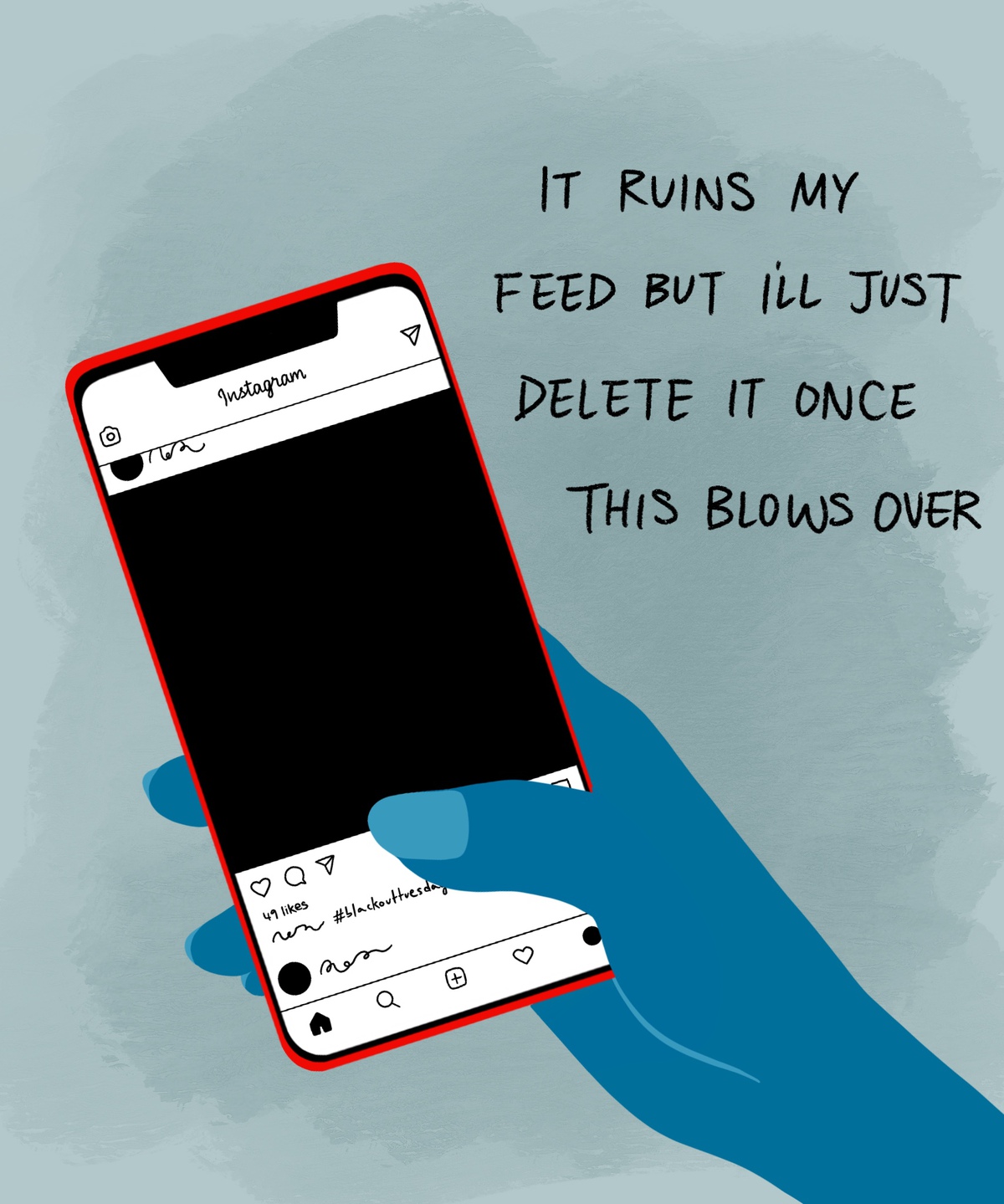
What is performative activism, you might ask? Well, performative activism is essentially just posting because others around you are. Or even just out of guilt. Performative activism is extremely counterproductive because it promotes a mentality that merely posting about an issue once, and then forgetting about it, is sufficient. . But that’s not how it should be. Being a genuine ally isn’t limited to just social media. It’s so much more than just an Instagram story post that expires after 24 hours. Some examples of performative activism include (but are not limited to) #BlackOutTuesday and picking the issues you want to post about.

Source: https://dailybruin.com/2020/06/10/second-take-performative-activism-fails-to-prompt-meaningful-long-term-systemic-change

What does genuine allyship look like? Being a true ally involves taking the extra step to help the causes you’re advocating for around you. It’s about having conversations (even if they’re tough) with peers and loved ones when you see they’re doing something problematic. It’s about applying the knowledge you’ve learned and being willing to expand that knowledge even more the more you learn.

To me, being an ally means being there for the good and the bad. It means caring more about your social media presence and using your platform to engage in actual change. Turn your anger for the inequality of these issues into passion by donating to charities, writing letters to authorities in your area, signing petitions, taking the initiative to start a club for a particular cause, and going to a protest/march. 

Being an Ally is Hot

Written by: Abigail Mathews

Being an ally is hot. 

An ally uses their power to stand up for a person or group that is facing discrimination or injustice,

An ally understands that educating themselves is entirely up to them,

An ally uses the benefits of their privilege to support those lacking it,

An ally is someone who amplifies the voices of those who are oppressed before their own,

An ally doesn’t play “devil’s advocate”(cause no one ever asks for that),

An ally means working in solidarity to re-learn and re-evaluate a society that marginalizes various types of people,

An ally is not an identity but a practice because an ally is constantly working on taking accountability with marginalized groups and is reflected not on them but by the people they seek to ally themselves with,

An ally is peace, equity and progress wrapped into one,

Everyone should be an ally no question because,

Being an ally is hot.

Various Forms of Discrimination & the Within Group Allyship We Must Cultivate

Written by: Shayla Joshi

I often find myself questioning my identity as a woman of colour, and when this internal dialogue arises, I find myself validating my identity by analyzing my experiences. 

Have I even been racially discriminated against?  

Well, before I even start with that I must ask: what is discrimination? Racial discrimination can range from physical violent acts to microaggressions – the latter of which is often overlooked. The overarching theme in all forms of discrimination seems to be distinguishing an individual based on a categorical aspect like race or gender. 

Being physically harmed as a result of an individual’s race, also known as physical racism, clearly adheres to the definition of discrimination. Microaggressions are often overlooked as they involve a passive form of discrimination – a racial minority is viewed and treated differently. 

As someone who has been on the receiving end of microaggressions, I find myself falling into the trap of overlooking my own experiences. This leads me to question whether I even qualify as a woman of colour and if I have been discriminated against. These thoughts are ludicrous because my identity is not prescribed to me – it stems from my own, honest experiences.

During this past September’s QWOCC general member meeting about “Reconnecting to Roots,” I realized that though the racism I have faced is not overt, it is not invalid. We were discussing the commonly asked question of “Where are you from?” when the realization hit me that this question is a microaggression. From this point, I sent myself into a spiral analyzing my past experiences: 

When I was consistently set up with one of the only other Indian guys in high school – was this a microaggression? 

When it was assumed that if I got a bad mark my parents would be mad at me – was this a microaggression? 

When people always ‘joke’ about me getting an arranged marriage – is this a microaggression? 

Yes, yes, and yes. Discrimination takes many different forms, which is why allyship within and between groups is so important. As a result of slow but consistent change, there seems to be a generational shift from the predominantly physical or verbal overt abuse and violence faced by racialized populations 20 years ago. Now, microaggressions have become a subdued norm; as they are not direct, they are easy to overlook and get away with. 

This discrepancy has created what I observe as a generational gap – oftentimes, the differences in experiences from 20 years ago and now have resulted in difficulties seeing eye-to-eye on what discrimination entails. I’ve seen this manifest as a ‘tit for tat’ situation wherein individuals from 20 years ago who have been on the receiving end of violent racism cannot fathom how a microaggression qualifies as a form of discrimination. This is where allyship and education come in. Though people’s experiences from 20 years ago are not the same as experiences of today, neither individual should feel invalidated. Each and every instance of discrimination, however it may present itself, is an individual’s legitimate experience. Within racial groups, we need to collectively acknowledge that racism can and will present itself in many forms. 

We must continue educating individuals from older generations while simultaneously appreciating their experiences and the action they took to allow us to be where we are today. We must acknowledge that discrimination, in whatever form, is not a determining factor of whether an individual is a minority. Furthermore, we must recognize that the central goal of group allyship is to create a community where individuals feel seen and heard. 

Design a site like this with WordPress.com
Get started